
Summary
If another driver or an insurer claims that you were speeding before a Pennsylvania motorcycle crash, you can challenge that allegation with photographs, video, witness accounts, physical measurements, and accident reconstruction. A statement that your motorcycle appeared fast is not the same as a measured speed. Even proof of speeding does not, by itself, establish that you caused the collision. Fault depends on the conduct of everyone involved and whether that conduct contributed to the crash.
If you were injured in Lancaster, Pennsylvania, or a nearby area, preserve available evidence promptly, obtain medical care, and review the basis for any disputed speed estimate. Pennsylvania comparative negligence rules can affect the compensation available when responsibility is shared.
Why Do Drivers Sometimes Assume a Motorcycle Was Speeding?
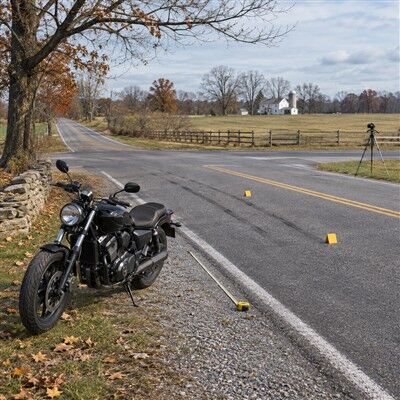
A driver may misjudge the distance or approach of a motorcycle, particularly when turning across traffic or entering an intersection. Witnesses may also describe a motorcycle as moving fast without knowing its actual speed. Their statements can help investigators understand what occurred, but those impressions should be checked against objective evidence.
Imagine that you are riding straight through an intersection in Lancaster when a driver turns left into your path. After the impact, the driver states that you appeared suddenly and must have been speeding. That statement raises questions rather than resolving them. Investigators should examine visibility, right-of-way, vehicle positions, the timing of the turn, and the evidence supporting any speed estimate.
Does Speeding Automatically Make a Motorcyclist Responsible for a Crash?
No. Pennsylvania law distinguishes between exceeding a posted speed limit and driving at a speed that is unsafe for existing conditions. Under 75 Pa.C.S. § 3361, a driver must use a reasonable and prudent speed in light of actual and potential hazards. Section 3362 addresses maximum lawful speeds.
A speeding violation may be relevant to a negligence claim, but the investigation must also consider whether the speed contributed to causing the collision or the resulting harm. Another driver’s failure to yield, distraction, or unsafe turn may also have contributed.
Questions that can clarify responsibility include:
- Did reliable evidence establish the motorcycle’s speed?
- What was the posted speed limit, and what were the road and weather conditions?
- Did the other driver keep a proper lookout and yield when required?
- How much time and distance did each driver have to respond?
- Would a different speed likely have changed the collision or its severity?
You can also read about Pennsylvania motorcycle accident compensation and investigations.
“Highly Recommended” is the epitome of an understatement when it comes to the firm of McDonald At Law!! Michael McDonald’s genuine pleasant, and empathetic demeanor masks his legal astuteness, and the level of aggressiveness he implements in pursuit of a victim’s right and the monetary compensation legally entitled to us. I was involved in a motor vehicle accident at the hands of an intoxicated driver in York County. In my case I suffered what I described as an atypical injury, Mr. McDonald offered to be my Lawyer immediately after explaining to him the events leading to and after being struck in turn causing me to have a heart attack, when another law firm seemed hesitant. McDonald At Law secured a sizable monetary compensation that not only met my expectation but exceeded it. Mr. McDonald’s wealth of experience, and legal prowess is priceless and never did he act as the case was beneath his practice. In the end my family and I were well compensated, but also felt justified. Thank you McDonald At Law!!
- Miguel Lopez
What Evidence Can Challenge an Unfair Speed Assumption?
The strongest response to an unsupported speed allegation is evidence that can be independently examined. Depending on the crash, useful materials may include the following.
Photographs, Road Conditions, and Physical Evidence
Photographs taken soon after the crash may show vehicle resting positions, debris, impact locations, road markings, traffic controls, and sightlines. Investigators may examine braking marks, surface conditions, vehicle damage, and the geometry of an intersection. No single detail, including extensive motorcycle damage, reliably proves speed on its own.
Dashcam, Surveillance, and Other Video
Nearby businesses, motorists, and property owners may have recordings of the events leading to a collision. Video can show traffic movements, a driver’s turn, or the operation of traffic signals. When reliable timing and reference measurements are available, a qualified expert may be able to estimate vehicle speed. Ask the recording owner to preserve original footage as soon as possible because systems may overwrite it.
Independent Witness Accounts
A witness may identify where the vehicles were before the crash, which lane they occupied, or whether a driver stopped or yielded. Investigators should consider the witness’s vantage point, view obstructions, and how long the motorcycle was visible. An impression that a rider looked fast is different from a scientifically supported speed calculation.
Police Reports and Other Records
A police crash report may contain observations, statements, diagrams, and conclusions. Review the report for errors and ask the investigating agency about its procedures for submitting additional information or requesting a correction. A recorded estimate or witness allegation in a report should be assessed with the other evidence; the report does not automatically decide civil fault.
A claim that you were speeding deserves evidence, not guesswork. Preserve original records and ask how the estimate was reached.
How Can Accident Reconstruction Help?
Accident reconstruction specialists use physical measurements, engineering methods, vehicle dynamics, photographs, recordings, and other available information to analyze how a collision occurred. Their findings may help assess braking distances, impact location, visibility, or the reliability of competing speed estimates.
A reconstruction may examine:
- Measurements of tire marks, lanes, road grade, and sightlines.
- Vehicle damage and the direction of impact.
- Video timing and available electronic data.
- The sequence of movement before and during the collision.
- Whether the available information supports a reliable speed estimate at all.
An expert may determine that the evidence does not support a precise motorcycle speed. That limitation is important when another party relies on an unverified number. The result will depend on the evidence available in your specific case.
Related Videos
Putting off an Attorney due to Cost
Choosing a Personal Injury Attorney
How Does a Disputed Speed Claim Affect Insurance and Fault?
An insurance company may argue that your speed caused the crash or made your injuries worse. Ask what evidence supports that conclusion. The analysis should account for the other driver’s conduct and the relationship between any alleged speeding and the collision.
Under Pennsylvania’s modified comparative negligence rule, 42 Pa.C.S. § 7102, your negligence generally does not bar recovery when it is not greater than the causal negligence of the defendant or defendants against whom recovery is sought. Any damages are reduced by the percentage of negligence assigned to you. If that percentage exceeds 50% in a typical two-party negligence claim, recovery is generally barred.
For example, if your proven damages total $100,000 and you are assigned 20% of the negligence, the amount after that reduction would generally be $80,000, before other legal and insurance considerations. A disputed speeding allegation matters because a change in the supported fault allocation may change the amount recoverable.
For additional context about the comparative negligence rule in motorcycle cases.
Verdicts & Settlements
What Should You Do After Someone Accuses You of Speeding?
Your health and the preservation of evidence come first. If you are physically able after receiving necessary medical care, consider these steps:
- Request a copy of the police crash report and identify statements or estimates that you dispute.
- Keep photographs, original recordings, messages, damaged equipment, and available repair information.
- Record witness names and contact details as soon as possible.
- Write down your recollection of traffic conditions and vehicle movements while the details are fresh.
- Ask owners of nearby cameras to preserve recordings, and retain the original files when available.
- Avoid guessing about an exact speed that you cannot reliably establish.
- Consider legal advice before giving a detailed recorded statement to the opposing driver’s insurance company.
Preserve evidence as it exists. Do not alter photographs, recordings, or motorcycle components to support a theory. If an investigation requires an inspection, ask how the items should be stored and documented.
Can You Recover Compensation When Motorcycle Speed Is Disputed?
Yes. A disputed speed allegation does not automatically end an injury claim. Compensation depends on the evidence of fault, the injuries and losses proven, available insurance coverage, and other legal requirements.
Depending on your circumstances, recoverable losses may include:
- Medical treatment, rehabilitation, and related expenses.
- Lost income and reduced future earning capacity.
- Property damage.
- Physical pain, emotional distress, and other legally recoverable noneconomic harm.
Medical records, bills, employment documents, and appropriate professional opinions can help connect your losses to the accident. Before resolving a claim, you should reasonably understand the nature of your injuries and any expected future care.
How Long Do You Have to File a Motorcycle Injury Claim in Pennsylvania?
Pennsylvania generally applies a two-year limitation period to personal injury lawsuits under 42 Pa.C.S. § 5524. The applicable start date and exceptions depend on the circumstances. Claims involving governmental parties may also be subject to earlier notice requirements, including provisions in 42 Pa.C.S. § 5522. Prompt review can help you identify deadlines specific to your claim.


Frequently Asked Questions About Motorcycle Speed Allegations
Can motorcycle damage alone prove that I was speeding?
No. The location and extent of damage are influenced by several factors, including collision angle, vehicle construction, and relative movement. A reliable assessment considers the full body of evidence.
What if the other driver incorrectly claims that I was speeding?
You can dispute the claim using video, scene evidence, witness accounts, and appropriate expert analysis. The question is whether the allegation is supported and whether any established speed contributed to the collision.
Can I challenge a speed estimate in a police crash report?
You may contact the investigating agency about its procedures for additional information or corrections. Independent evidence can also be used to dispute an estimate in an insurance claim or civil case.
Will every motorcycle case need a reconstruction expert?
No. An expert may be useful when speed, visibility, braking, or the timing of a turn is seriously disputed. The need depends on the evidence and the issues in your case.
Get Help Challenging a Motorcycle Speed Allegation in Lancaster, Pennsylvania
If you were hurt in a motorcycle crash and a speeding allegation is affecting your claim, McDonald At Law can review the circumstances and discuss your options. The firm is based in Lancaster, Pennsylvania, and serves Lancaster County, Central Pennsylvania, and nearby areas. Michael P. McDonald is a board-certified trial specialist through the National Board of Trial Advocacy.
Contact the firm to request a consultation or use the firm’s contact page
This article provides general information and is not legal advice. Speak with a Pennsylvania attorney about the facts and deadlines that apply to your situation.
Featured Image Details
Suggested image: A motorcycle rider beside a parked motorcycle while an investigator photographs roadway evidence in daylight. No crash injuries, lettering, or numbers.
Alt text: Pennsylvania motorcycle rider stands beside a motorcycle as an investigator documents roadway evidence.
Caption: Preserving physical evidence can help challenge unsupported speeding allegations after a motorcycle crash.
Image URL: Add the final uploaded image URL before publication. The draft image filename has not been verified.
BlogPosting Schema (JSON-LD)

   |    |