
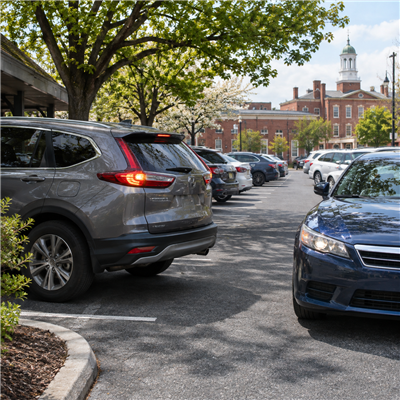
When a moving vehicle hits your car while you are backing out of a parking space in Lancaster, Pennsylvania, either driver or both drivers may be responsible. Pennsylvania law generally requires a reversing driver to make sure backing is safe and to yield to moving traffic and pedestrians. The other driver must also use reasonable care. The vehicles’ positions, speed, visibility, and available evidence help determine fault. If you suffered injuries, Pennsylvania’s comparative negligence rule may reduce your recovery based on your percentage of responsibility.
Who Is Usually Responsible for a Parking Lot Backing Accident?
The driver leaving a parking space often has a greater responsibility to check for approaching traffic before reversing. Still, fault is based on what happened, not on the assumption that the reversing driver always caused the crash.
An approaching driver may share responsibility when that driver travels at an unsafe speed, fails to watch the parking aisle, or has enough time to respond to a clearly visible vehicle but fails to act reasonably.
Key point: A car backing out of a space is not automatically 100% at fault. Both drivers’ actions must be evaluated.
What Does Pennsylvania Law Say About Backing Out?
Under 75 Pa.C.S. § 3702, a driver may back a vehicle only when the movement can be made safely, without interfering with other traffic, and after yielding to moving traffic and pedestrians. Whether the statute governs a particular incident on private property requires attention to the location and applicable law. Even when a specific traffic statute does not apply, ordinary negligence principles may govern a driver’s conduct.
Before and during a reversing maneuver, drivers should:
- Check mirrors, blind spots, and the area behind the vehicle.
- Watch for moving vehicles and pedestrians.
- Reverse slowly and continue observing the parking aisle.
- Stop when the maneuver cannot be completed safely.
- Use backup cameras and sensors as aids rather than substitutes for looking.
Section 3324 addresses certain entries onto or crossings of a highway from a place other than another highway. Its relevance to an individual parking lot collision depends on the property layout and facts. A suspected statutory violation does not, by itself, determine the final allocation of civil liability.
Pennsylvania statutory reference: https://www.legis.state.pa.us/WU01/LI/LI/CT/HTM/75/00.037.002.000..HTM


Can the Driver Traveling Through the Parking Lot Be at Fault?
Yes. A driver traveling through a parking lot must respond reasonably to visible hazards, including vehicles entering the aisle. A driver may contribute to a collision by:
- Driving too quickly for pedestrian activity or limited sightlines.
- Looking at a phone or another distraction.
- Passing too closely to parked or moving cars.
- Failing to keep a reasonable lookout.
- Failing to brake or steer when there was a reasonable opportunity to avoid impact.
For example, assume you checked the aisle and began to reverse at a Lancaster shopping center. Another driver approached at an unsafe speed and struck the side of your vehicle. Your decision to reverse and the approaching driver’s speed may both require examination. The damage pattern may help investigators reconstruct the collision, but it does not decide fault on its own.
How Does Comparative Negligence Affect Compensation?
Pennsylvania uses a modified comparative negligence rule under 42 Pa.C.S. § 7102. In a typical two-driver negligence case, you can generally recover if your share of fault is 50% or less. Your damages are reduced by that percentage. If you are more than 50% responsible, recovery from the other driver is generally barred. Cases with multiple defendants can involve additional allocation rules.
Suppose the compensable damages are $20,000:
- If you are 30% responsible, the reduction is $6,000, leaving $14,000.
- If you are 60% responsible in a two-driver case, you generally cannot recover from the other driver.
These figures illustrate the law; they are not estimates of the result in your case. Insurance adjusters may take different positions on fault, and an insurer’s initial determination is not necessarily the final legal result.
Pennsylvania statutory reference: https://www.legis.state.pa.us/WU01/LI/LI/CT/HTM/42/00.071.002.000..HTM
What If Both Cars Were Backing Out at the Same Time?
When two drivers reverse from spaces on opposite sides of a parking aisle, both may have had a duty to check for movement before continuing. Neither driver automatically receives priority simply because both vehicles were backing.
Investigators may assess:
- Which vehicle began reversing first and where each vehicle was positioned.
- Whether either driver could see the other car.
- Whether either vehicle stopped before impact.
- Whether a driver could reasonably have avoided the collision.
- What surveillance footage and independent witnesses show.
Both drivers may share fault if their actions contributed to the collision.
Does the Location of Vehicle Damage Prove Fault?
Damage to a rear bumper, rear quarter panel, or side door can help indicate the direction of impact and each vehicle’s movement. Yet a single photograph usually cannot prove who had the right of way or who acted carelessly.
Investigators consider the damage together with vehicle positions, witness descriptions, surveillance videos, visibility obstructions, and evidence of whether either vehicle was stopped before the collision.
What Evidence Helps Prove Responsibility?
Preserving evidence promptly can make a major difference when drivers disagree about the sequence of events. Useful records include:
- Photographs of both vehicles and the surrounding parking spaces.
- Pictures of aisle markings, signs, and obstructions.
- Contact details for witnesses.
- Dashcam or nearby business surveillance footage.
- Police and insurance information.
- Medical records, treatment bills, and notes about symptoms.
Nearby businesses may overwrite security footage, so a prompt preservation request may help protect recordings.
For a related checklist, read: /what-information-should-you-collect-after-an-accident/
“Highly Recommended” is the epitome of an understatement when it comes to the firm of McDonald At Law!! Michael McDonald’s genuine pleasant, and empathetic demeanor masks his legal astuteness, and the level of aggressiveness he implements in pursuit of a victim’s right and the monetary compensation legally entitled to us. I was involved in a motor vehicle accident at the hands of an intoxicated driver in York County. In my case I suffered what I described as an atypical injury, Mr. McDonald offered to be my Lawyer immediately after explaining to him the events leading to and after being struck in turn causing me to have a heart attack, when another law firm seemed hesitant. McDonald At Law secured a sizable monetary compensation that not only met my expectation but exceeded it. Mr. McDonald’s wealth of experience, and legal prowess is priceless and never did he act as the case was beneath his practice. In the end my family and I were well compensated, but also felt justified. Thank you McDonald At Law!!
- Miguel Lopez
What Should You Do After a Lancaster Parking Lot Crash?
After a parking lot collision, focus first on safety and medical needs. Take the following steps when you can do so safely:
- Check for injuries and call 911 when emergency help is needed.
- Move to safety when it is possible to do so without causing further danger.
- Exchange identification, registration, and insurance information.
- Photograph the vehicles and scene before moving them, if safe.
- Collect witness information and request available video preservation.
- Report the crash to your insurer as required by your policy.
- Seek medical evaluation for pain, dizziness, or other potential injury symptoms.
Pennsylvania requires immediate police notification in certain crashes involving injury, death, or damage requiring a vehicle to be towed, subject to the statutory requirements. Other reporting duties may apply depending on the circumstances.
Read more about post-crash steps: /what-steps-should-you-take-after-a-car-accident/
Can You Recover Compensation for Injuries?
A parking lot crash can cause neck and back injuries, concussions, and other conditions that require treatment. Depending on the facts and applicable coverage, potential damages may include medical costs, lost earnings, reduced earning capacity, and pain and suffering.
Pennsylvania motor vehicle insurance rules can affect these claims. First-party medical benefits may pay certain expenses without regard to fault, within coverage terms and statutory limits. Your full tort or limited tort election can also affect claims for noneconomic losses, subject to statutory exceptions.
Read the explanation of tort choices: /limited-v-full-tort-insurance-what-is-the-difference/
An injury claim and a vehicle damage claim can involve different insurance coverages and procedures.
What If an Insurance Company Disputes Liability?
An insurer may argue that the reversing driver entered the travel aisle without yielding. Another insurer may contend that the approaching driver was distracted, speeding, or able to avoid the crash. Each position should be tested against the evidence.
Keep copies of adjuster correspondence, photographs, bills, and medical documentation. Before signing a settlement release, understand which claims it resolves and whether treatment and losses have been fully evaluated.
How Long Do You Have to File a Lawsuit?
Under 42 Pa.C.S. § 5524, Pennsylvania generally provides two years to file negligence-based personal injury lawsuits and many property-damage lawsuits. The period usually begins on the date of the crash, although exceptions may apply. Insurance claim reporting deadlines may be shorter, and notifying an insurer does not necessarily extend the deadline for a lawsuit.
Pennsylvania statutory reference: https://www.legis.state.pa.us/WU01/LI/LI/CT/HTM/42/00.055.024.000..HTM
How Can a Lancaster Car Accident Attorney Help?
A car accident attorney can review each driver’s conduct, seek available recordings, evaluate the significance of traffic rules, and examine how comparative negligence and available insurance may affect a claim. An attorney can also communicate with insurers, review medical records, negotiate a settlement, and file a lawsuit when appropriate.
Related Videos
Putting off an Attorney due to Cost
Choosing a Personal Injury Attorney
Speak With a Lancaster Car Accident Attorney
If another vehicle struck your car as you backed out of a parking space in Lancaster, Pennsylvania, McDonald At Law can review your circumstances and explain potential next steps. The firm handles personal injury matters in Lancaster County and nearby areas of Central Pennsylvania. Its attorneys bring substantial experience with motor vehicle injury claims.
Contact the firm for guidance.
This article provides general information and is not legal advice. The application of law to your situation depends on the specific facts.

 
 |

 |